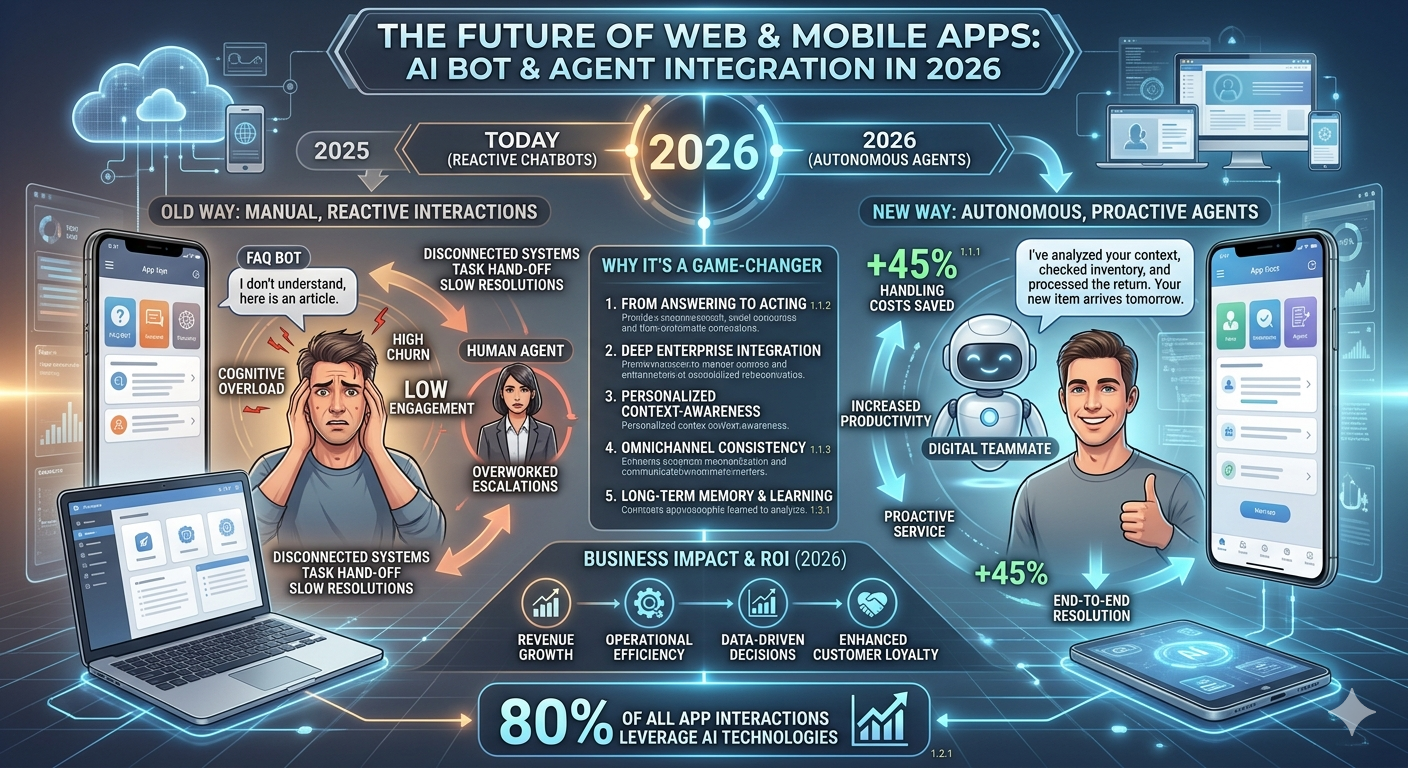
Your competitor just launched an app that answers customer questions at 2 AM, qualifies sales leads without a single human touchpoint, and personalizes every user’s experience based on their behavior in real time.
Your app shows a contact form and a phone number.
This isn’t a minor product gap. It’s the difference between a business that scales and one that stagnates. In 2026, the divide between static digital products and AI-powered applications has become impossible to ignore — and the businesses closing that gap fastest are pulling ahead in ways that are very difficult to reverse.
This article breaks down exactly what that shift looks like technically, what it means for your product, and how businesses investing in custom AI bot integration right now are building a structural advantage over everyone else still running conventional apps.
Section 1: Custom Web & Mobile App Development in 2026 — Static Is No Longer Enough
There was a time when having a clean, responsive website or a well-designed mobile app was a genuine competitive edge. Those days are gone.
Today, a static app — one that displays content, takes form submissions, and waits for a human to act — is table stakes at best. Users expect more. They expect the application to anticipate what they need, respond instantly, and adapt to how they personally use the product. When it doesn’t, they leave. The average mobile session lasts under three minutes, and users make the decision to abandon within the first thirty seconds of friction.
Generic no-code and low-code platforms can produce a working app, but they produce the same working app that hundreds of other businesses in your space are running. The visual differences are cosmetic. The underlying functionality is identical. There is no proprietary logic, no custom automation, and no intelligence baked into the product.
Why Custom Engineering Is the Only Way Forward
Custom web and mobile app development is no longer just about brand differentiation at the UI level. It’s about building a product with proprietary logic, integrations, and intelligence that no off-the-shelf platform can replicate.
When TechShield engineers a product, the architecture is designed from the start to support the kind of functionality that turns a digital product from a static brochure into an active business asset. That means designing systems where AI components aren’t bolted on as an afterthought — they’re first-class citizens of the application architecture.
The businesses winning in their categories right now aren’t the ones with prettier interfaces. They’re the ones with smarter systems.
Section 2: The Rise of AI Bots and Autonomous Agents Inside Modern Applications
Let’s be precise about what we mean by AI bots and agents, because the term gets used loosely and it matters.
AI Bots are automated programs that handle defined conversational or procedural tasks — answering FAQs, collecting user information, routing support tickets, sending follow-ups. They’re fast, consistent, and available 24/7. A well-built AI bot handles the predictable 80% of user interactions so your human team can focus on the 20% that actually requires judgment.
Autonomous AI Agents go further. They don’t just respond — they act. An agent can monitor a set of conditions, make decisions, execute multi-step workflows, and report back on outcomes without any human triggering each step. Think of an agent that watches your inventory system, identifies stock thresholds, generates a purchase order, gets it approved through an internal workflow, and logs the transaction — all without a single human click.
Both types are now deeply integrated into modern production applications, and the gap between businesses running them and those that aren’t is growing every quarter.
Where AI Bots Are Being Deployed in Real Applications
Customer Support and Engagement The most visible deployment. A custom AI bot integrated into your web or mobile app handles incoming user queries using a large language model trained or prompted on your product knowledge base. It doesn’t just keyword-match to a FAQ page — it understands context, handles follow-up questions, escalates intelligently, and maintains conversation history across sessions.
Lead Qualification and Sales Assistance An AI bot embedded in your website or app can qualify a lead through a structured, conversational flow — asking the right questions, scoring responses, and routing high-intent prospects directly to your sales team in real time. Low-intent leads get nurtured automatically through a follow-up sequence.
Personalized User Journeys AI agents track user behavior within the app — what features they use, what they skip, where they drop off — and dynamically adjust what the application shows them. An e-commerce platform surfaces different product recommendations for different users based on real-time behavioral data, not just purchase history.
Automated Internal Workflows Bots aren’t just customer-facing. Inside your operations, AI agents automate report generation, data reconciliation, approval routing, and notification management. Processes that require three team members and two hours now run autonomously in the background.
Section 3: The Tech Stack Behind AI Integration in Modern Apps
Understanding how this actually works at the engineering level matters for any CTO or technical decision-maker evaluating whether to invest. The good news: modern frameworks make AI integration significantly more tractable than it was even 18 months ago.
Frontend — Next.js and React Native
For web applications, Next.js is the dominant choice for AI-integrated products in 2026. Its server-side rendering capabilities, combined with its API route layer, make it straightforward to build interfaces that stream AI responses in real time — giving users the feel of a live, thinking conversation rather than a loading spinner.
On mobile, React Native allows a single codebase to power both iOS and Android with near-native performance. React Native’s architecture now supports real-time WebSocket connections cleanly, which is essential for live bot interactions in mobile apps.
Backend — Python and Node.js
Python is the language of AI engineering. The ecosystem around LLM integration, data processing, vector databases, and ML inference is Python-native. Backend services handling AI logic, agent orchestration, and LLM API calls are almost universally built in Python in modern architectures.
Node.js handles the high-concurrency, real-time communication layer — managing WebSocket connections, webhook processing, and event-driven triggers that keep the AI layer synchronized with your application state.
Connecting to LLMs — OpenAI, Gemini, and Custom Models
The brain of the AI bot is the large language model it calls. In production applications, this typically means API connections to OpenAI’s GPT-4o, Google’s Gemini API, or increasingly, self-hosted open-source models like Llama 3 for businesses with strict data privacy requirements.
The integration pattern looks like this: user input from your React Native or Next.js frontend reaches your Python backend, which enriches the input with relevant context (user history, product data, session state), constructs a structured prompt, calls the LLM API, and streams the response back to the client.
Custom Webhooks and Orchestration
The real engineering sophistication happens in the orchestration layer. Custom webhooks allow your AI agents to trigger and receive information from external systems — your CRM, your ERP, your payment gateway, your logistics provider.
Frameworks like LangChain and LangGraph are used to build multi-step agent pipelines where an AI agent can use external tools, query databases, call APIs, and chain reasoning steps together. This is what separates a simple chatbot from a genuinely autonomous business agent.
Vector Databases for Long-Term Memory
Standard LLMs have no memory between sessions by default. In production applications, vector databases like Pinecone or Weaviate store embeddings of your user data, product information, and conversation history. When a user returns to the app, the AI retrieves the relevant context and responds as if it remembers — because architecturally, it does.
This combination — LLM reasoning power, vector memory, webhook integrations, and real-time frontend rendering — is the full stack behind a modern AI-powered business application. It’s not experimental anymore. It’s production-ready, and TechShield deploys it in client projects regularly.
Section 4: Real-World Business Impact — The Numbers That Justify the Investment
24/7 Customer Engagement Without 24/7 Headcount
A business running a custom AI bot on its web and mobile application is serving customers at 3 AM on a Sunday with the same quality response it gives at 10 AM on a Tuesday. There’s no after-hours drop in service quality, no ticket backlog waiting for Monday morning, and no customer left waiting.
For businesses operating across time zones — or simply for e-commerce and SaaS companies with a global user base — this is not a nice-to-have. It’s a core operational capability that directly affects conversion rates and customer retention.
50% Reduction in Customer Service Costs
The economics are straightforward. A well-designed AI bot handles tier-1 support — password resets, order status checks, basic troubleshooting, policy questions, billing inquiries — at essentially zero marginal cost per interaction.
Businesses that have deployed custom AI-powered business applications in their support workflows consistently report 40–60% reductions in the volume of queries that require a human agent. Your human support team shifts from answering repetitive questions to resolving complex issues, managing escalations, and building customer relationships — work that actually requires human judgment.
The cost per resolved support interaction drops dramatically. At scale, this represents one of the highest ROI investments any digitally active business can make.
Instant Lead Qualification at Scale
Traditional lead qualification is slow and expensive. A sales development rep manually works through inbound leads, sends emails, makes calls, and tries to identify which prospects are actually worth a full sales cycle. It’s time-consuming and, at high inbound volumes, it breaks.
An AI bot embedded in your web or mobile app qualifies leads conversationally at the point of contact. It asks the right questions, scores intent signals, segments by product line or use case, and routes hot leads to the sales team in real time — with a full conversation transcript and qualification summary attached.
The outcome isn’t just faster qualification. It’s qualification that happens at every inbound touchpoint, at any volume, without degradation in quality. A business doing 100 inbound leads per month and one doing 10,000 per month get the same quality of first-touch qualification.
Personalization That Drives Retention
Generic applications treat every user the same. AI-powered applications adapt. A user who consistently uses certain features of your mobile app gets a home screen optimized around those features. A user who’s browsed a specific product category five times gets a prompt that’s contextually relevant to that interest.
Personalization at this level was previously only accessible to businesses with massive data science teams. Modern AI integration makes it accessible to any business willing to invest in engineering it correctly. The retention impact is significant — personalized digital experiences consistently outperform generic ones by 30–40% on key engagement metrics.
Actionable Steps You Can Take Right Now
- Audit your current app for automation gaps. Identify the three most repetitive user interactions your support or sales team handles. Those are your first bot deployment targets.
- Evaluate your existing tech stack. AI integration works best when the underlying application is built on modern, API-first architecture. If your app is running on legacy infrastructure, that assessment needs to happen before AI integration begins.
- Define success metrics before you build. Decide in advance what a successful AI bot deployment looks like — response resolution rate, lead qualification speed, support cost per ticket. Build toward measurable outcomes.
- Start with a focused scope. Don’t try to automate everything at once. A single, well-engineered AI workflow delivering measurable results justifies the broader investment and teaches you what to build next.
- Choose an engineering partner who owns the full stack. AI bot integration done well requires frontend engineering, backend architecture, LLM prompt engineering, and data infrastructure expertise working together. Avoid vendors who can do one piece and will subcontract the rest.
TechShield Builds the Applications That Businesses Actually Need in 2026
At TechShield, we specialize in web and mobile app development Pakistan and globally — from architecture to deployment — with AI integration as a core engineering discipline, not an optional add-on.
Our engineering teams build production-grade applications on Next.js, React Native, and Python backends, connected to LLMs, Gemini APIs, and custom orchestration layers that turn your application from a passive product into an active business system.
Whether you need a customer-facing AI bot that handles support and lead qualification, an internal agent that automates your operations workflows, or a fully custom AI-powered business application built from scratch, TechShield has the architecture and delivery track record to build it right.
We’ve delivered for clients in retail, logistics, healthcare, fintech, and professional services. We’re based in Lahore with a global delivery model, and we bring senior engineering talent to every engagement — not junior developers following a template.
The Window to Build a Sustainable Advantage Is Open — But Not Indefinitely
Businesses that invested in custom web and mobile development three years ago are ahead today. The businesses investing in AI bot integration and autonomous agents now will be ahead in 2028. The compounding effect of building smarter digital infrastructure early is real, and it gets harder to close the gap the longer you wait.
Your users already expect intelligence from the applications they use. The question isn’t whether AI belongs in your product — it does. The question is whether you build it now or spend the next two years watching competitors who did.
TechShield offers a free discovery consultation for businesses evaluating custom web and mobile app development and AI bot integration. We’ll assess your current product, identify the highest-impact automation opportunities, and walk you through exactly what a custom AI-powered application looks like for your specific business model.
Book your free consultation at techshield.com.pk
Build the application your business needs for 2026 — not the one that was good enough in 2021.
TechShield | Web and Mobile App Development Pakistan | Custom AI Bot Integration | AI-Powered Business Applications | Software Engineering Lahore | Business Automation Bots
Leave a Reply